
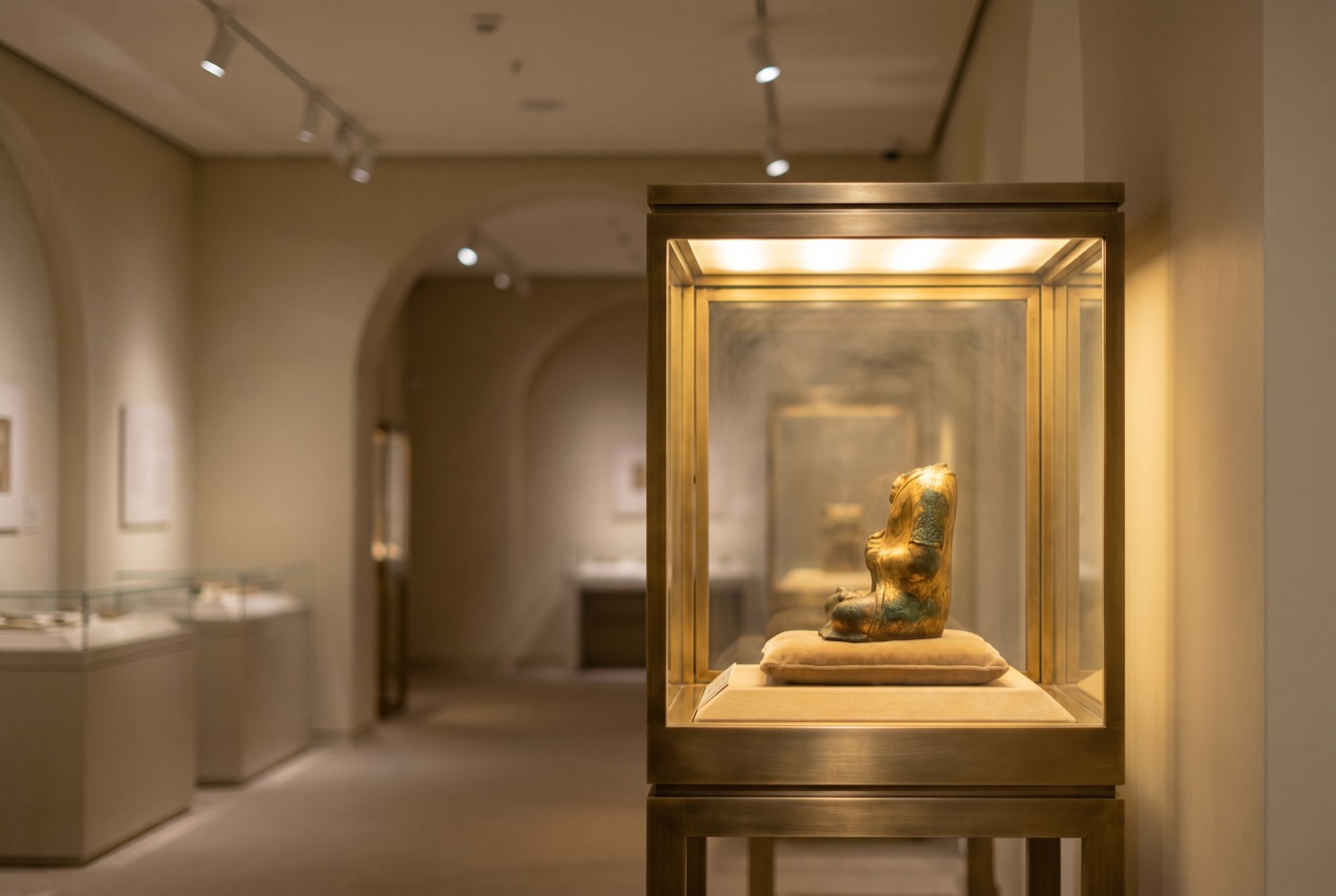
Humidity Control in Museum Display Cases: Stability Matters, Not Absolute Value
When discussing preventive conservation, attention almost always falls on the value of relative humidity (RH): 45%, 50%, 55%. But for an artwork, the greatest danger is not the percentage itself — it is its variation. It is the repeated fluctuations, day after day, that generate the stresses which warp wood, lift paint films and trigger metal corrosion.
Why stability matters more than the number
A hygroscopic material — wood, ivory, parchment, canvas — expands when it absorbs moisture and contracts when it releases it. In a case subject to oscillations (the night/day cycle, room openings, seasonal changes) it is precisely this continuous movement that produces, over time, cracks and detachment. Maintaining RH constant, even at a value that is not "perfect", is almost always more protective than chasing the ideal number while letting it fluctuate.
Absorbing is not enough: stabilization is needed
This is where the difference lies between ordinary silica gel and a dynamic humidity stabilizer. The former absorbs moisture until it saturates, then stops. The latter works both ways: it absorbs when the air is too humid and releases when it is too dry, bringing the environment back to the set value. Propadyn Museart is programmed between 35% and 80% RH, with a resolution of 3%, and maintains that value even when conditions outside change — without electricity and without maintenance.
What to check in your case
- What is the amplitude of RH oscillations over a 24-hour period, not just the average value?
- Is the case well sealed? A good microclimate starts with a low-permeability container.
- Is the material in contact with the artwork chemically inert (Oddy Test)?
- Is the dosage calibrated to the actual volume of the case?
On this last point you can start with the dosage calculator and then have the result validated by one of our technicians.


