

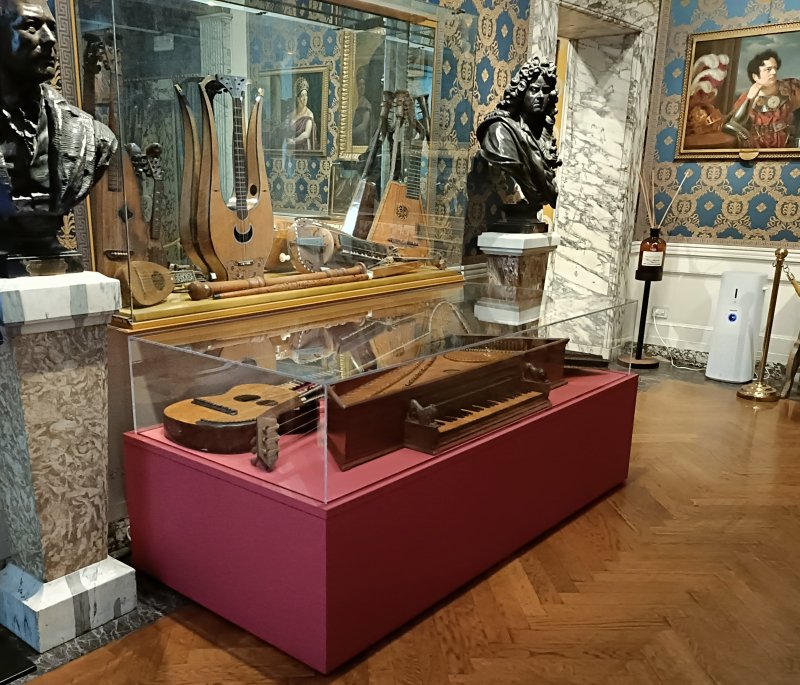
The Spinetta di Antegnati, the precious musical instrument from the Renaissance period made in 1544 by Giovanni Francesco Antegnati, has returned to the collection of the Theatre Museum at La Scala in Milan. After an elaborate restoration, the Spinetta di Antegnati is now displayed in the first room of the museum in a climate-controlled showcase protected from humidity fluctuations with Propadyn Museart, designed for the stabilization of the microclimate in exhibition environments.
The Spinetta di Antegnati: a masterpiece of the Renaissance
The Antegnati family, active between the 16th and 17th centuries mainly between Brescia and Northern Italy, represents one of the most important dynasties of organ and keyboard instrument builders of the Renaissance.
The spinet is a compact variant of the harpsichord, widely used in the courts and noble residences of the time. In addition to its musical value, these instruments today possess a very high historical-artistic relevance.
The structure of the Spinetta di Antegnati is predominantly made of solid wood, soundboard in precious woods, natural glues, metal strings, and painted decorations, all materials extremely sensitive to variations in relative humidity.
Why humidity control is crucial for historical musical instruments
The stabilization of humidity in museum showcases is essential to prevent structural damage and alterations over time to works of art and all those precious artifacts on display.
Humidity fluctuations can indeed cause:
The repetition of such fluctuations over time can compromise the stability of the work; for this reason, museum microclimate control is an essential strategy for preventive conservation.
Propadyn Museart acts as a high-efficiency hygroscopic regulator and is programmed to absorb and release humidity based on external environmental variations. This allows for stable relative humidity inside the showcase, reducing hygrometric fluctuations. Propadyn Museart thus protects sensitive organic materials and improves the long-term preservation of the work.
Solutions like Propadyn Museart also allow for:
Technology and cultural heritage protection
The protection provided by Propadyn Museart to the Spinetta di Antegnati demonstrates how technological innovation can concretely support the preservation of cultural heritage.
Propadyn Museart confirms itself as an effective solution in the museum field for humidity control, contributing to the safeguarding of historical instruments, works of art, and invaluable artifacts.


Propadyn Museart was born in Propagroup laboratories, a society leader in its field that has been working in the market for more than fifty years. Propagroup was born as a distributor of traditional packing products and has continued to evolve since then. Treasuring the experience built up in this field, Propagroup has continued specializing in the field of safety packing, which is suitable for protection of every kind of product under the severest transport and storage conditions.
To find out more about Propagroup and the products it offers visit www.propagroup.com

Via Genova 5/b
10098 Rivoli (Turin) - Italy
Tel. +39 011 9507788
P.IVA 03795670011
Email: export@propagroup.com
www.propagroup.com


